In short:
- SONCAS pinpoints the psychological driver behind a buyer’s decision so you can rephrase your arguments in their own language.
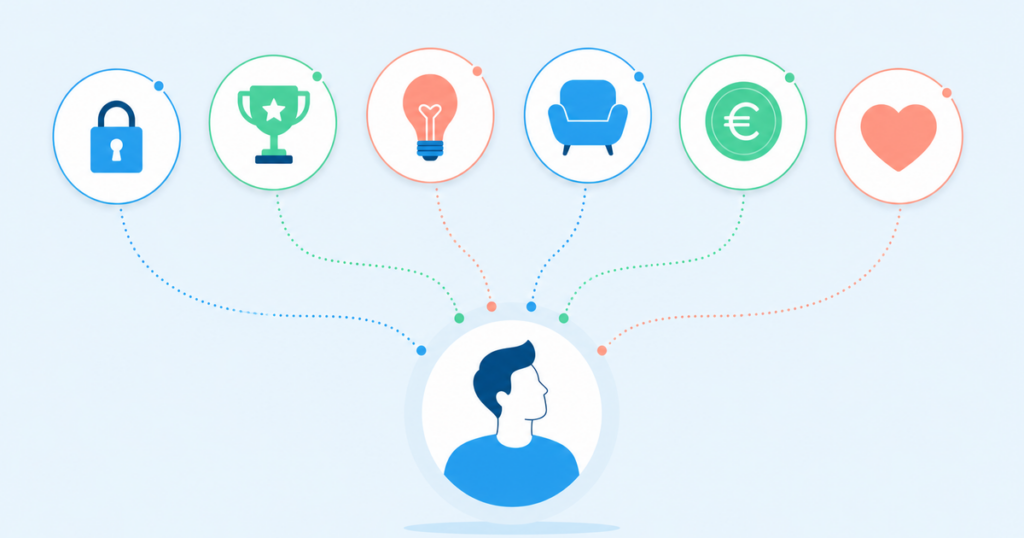
- Six drivers: Security, Pride (Orgueil), Novelty, Comfort, Money (Argent), Sympathy. The SONCASE version adds Ecology.
- The method works in two steps: spot the dominant driver during discovery, then build your pitch around it.
- A buyer almost always combines two or three drivers. SONCAS is a lens, not a label.
Two buyers looking at the same offer almost never buy for the same reasons. One wants reassurance, another wants the latest thing, a third looks at the price before anything else. The SONCAS method puts words on those buying drivers and helps you tailor the pitch to the person in front of you, instead of reciting the same product sheet to everyone.
It’s one of the most widely used methods in French sales teams, and it travels well beyond France. You can learn it in an afternoon and put it to work at your next meeting. Here’s how it works, how to spot each driver in a B2B setting, and how to build a pitch that actually speaks to the person on the other side of the table.
What does SONCAS stand for
SONCAS is a French acronym built from the six drivers behind any buying decision: Sécurité (Security), Orgueil (Pride), Nouveauté (Novelty), Confort (Comfort), Argent (Money), Sympathie (Sympathy). The idea fits in one sentence: you don’t sell a product, you respond to the buying driver of the person in front of you. The framework was formalised in the 1990s and remains a staple of sales in France.
The six drivers in detail, B2B edition
Each driver has its own signals and its own vocabulary. Here’s how to spot it in a professional buyer and how to talk to them.
Security
The need to avoid risk before chasing gain. In B2B, a Security profile piles on questions about guarantees, compliance, reliability, and references in their own industry. What lands: “you keep control, the data stays hosted in France, and here are three customers your size who’ve been using it for two years.”
Pride
Recognition and status. This profile wants to feel valued, to pick a solution that sets them apart, to belong to a certain club. They talk about image, about what the leaders in their market are doing. What lands: “this is what the sharpest sales teams are picking, you get a head start.”
Novelty
Attraction to innovation and to what others don’t have yet. This profile reacts to recent features and to different approaches. What lands: “this approach changes the way you work, and very few players offer it today.”
Comfort
Ease of use and peace of mind. Time savings, quick ramp-up, hand-holding when needed. This profile dreads complexity and painful change. What lands: “onboarding takes a day, and our team stays available throughout the roll-out.”
Money
The cost-benefit trade-off. This driver doesn’t mean cheapest, it means best justified. A Money profile talks about return on investment, savings, profitability, and payback periods. What lands: “two hours a week saved per sales rep, roughly half a full-time role over a year.”
Sympathy
The human relationship and the trust the buyer places in the salesperson. This driver is earned through the quality of the conversation, real listening, and keeping your word. It doesn’t announce itself, it gets built. A well-handled first contact, following the 4×20 rule, lays the groundwork for the Sympathy driver.
Spotting the dominant driver during discovery
SONCAS starts with listening. During sales qualification, the client’s own words give away their driver. A prospect who keeps coming back to guarantees is flagging a Security profile. Someone who talks margin and profitability leans toward Money. Anyone asking “who else in my industry uses it” mixes Pride and Security.
The rule: ask open questions, then stay quiet. The dominant driver reveals itself in what the client chooses to bring up, not in what you suggest. A good opener: “what matters most to you in this kind of decision?” The answer steers the rest of the conversation.
Pitching in the language of the driver
Once the driver is identified, the same benefit gets phrased in different ways. Take a piece of software that saves data-entry time:
- Comfort profile: “your reps stop filling out records on Friday evenings.”
- Money profile: “two hours a week saved per rep over the course of the year.”
- Security profile: “records stay up to date automatically, no more forgotten contact when it’s time to follow up.”
- Pride profile: “your team works with a tool few small businesses have mastered yet.”
Same feature, four different pitches. That’s the whole point of the method: it doesn’t change the product, it changes the way you tell the story.
SONCAS on the phone and by email
The method isn’t limited to face-to-face meetings. On a cold call, the driver shows up in the tone and word choice, and you can adjust your pitch live. In an email sequence, you don’t know the profile yet: the trick is to cover two or three different drivers across the messages (one Money-oriented email, one Security-oriented email), then watch which one triggers a reply. The prospect’s reaction gives you their driver.
SONCAS and FAB: structuring each argument
SONCAS tells you which driver to target. The FAB method (Feature, Advantage, Benefit, known as CAP in French for Caractéristique, Avantage, Preuve) tells you how to phrase the argument once the driver is chosen. The two combine under the name CAP-SONCAS: start from the dominant driver, then roll out a product feature, the concrete advantage it delivers on that driver, and a proof point (a number, a customer name, a live demo). It’s the most common pairing in structured sales scripts.
SONCASE and the ecology driver
The extended version, SONCASE, adds Ecology, which has turned into a real B2B buying criterion. For a share of buyers, environmental impact weighs as much as price, especially in public tenders and in large accounts bound by CSR commitments. The principle doesn’t change: one more buying driver to detect and to fold into discovery.
Combining SONCAS with other methods
SONCAS lights up the psychology, not the process. It pairs well with qualification frameworks like MEDDIC or BANT, which frame the opportunity, with SPANCO, which drives the cycle, and with the 4×20 rule for a strong first impression. For a broader view, our guide to B2B sales methods places each one in relation to the others.
The limits worth knowing
A buyer almost never has a single driver. Most decisions blend two or three motivations, sometimes contradictory ones. Reducing a person to one letter misses the reality: SONCAS is a lens, not a label. In complex sales, the buying committee makes it harder still. The CFO thinks Money and Security while the end user thinks Comfort. Adapting your message to each member of the committee is where the real work happens.
Where the CRM fits in
Spotting the driver is useless if it’s forgotten between two meetings. Logging the dominant profile on the contact record lets you find it again, prepare the next conversation, and hand it over if a colleague picks up the deal. A CRM that keeps a record of every exchange turns a rep’s gut feel into information the whole team can use.
Frequently asked questions
SONCAS or SONCASE, which one to use?
SONCASE is simply SONCAS with the Ecology driver added. Use SONCASE as soon as environmental impact could weigh in on your customers’ decisions, which is increasingly common in B2B and systematic in the public sector.
Does SONCAS work in complex sales?
Yes, provided you apply it to each member of the buying committee, not to the company as a whole. Every decision-maker has their own driver, and it’s the sum of those drivers that shapes the outcome.
How do you spot the driver without sounding intrusive?
By asking open questions about the context and the priorities, then listening to what the client volunteers. The driver shows up in their words, not in an interrogation.
What is the difference between SONCAS and FAB?
SONCAS identifies the buying driver to aim at, FAB (Feature, Advantage, Benefit, called CAP in French) structures the argument itself. You combine them as CAP-SONCAS: pick the driver, then roll out a proven argument that serves it.
Does SONCAS replace a product pitch?
No, it steers it. The pitch stays the same at its core, SONCAS just picks which of its benefits to bring forward depending on the profile in front of you.
Can you switch drivers mid-meeting?
Yes, and it’s often needed. A buyer sometimes reveals a second driver as the conversation moves on. Staying tuned in means you can adjust the pitch in real time rather than getting stuck on your first read.