Most prospecting failures do not come from a lack of effort. They come from a lack of structure. Reps contact people at random, follow up when they remember, and measure results by instinct. The outcome: a lot of time spent, very few meetings booked.
This guide walks through the 7 steps of a structured sales prospecting plan, from defining your target to measuring results. Every step is concrete and applicable, whether you work alone or as part of a team.
Why a prospecting plan is essential
Prospecting without a plan is like sailing without a map. You move forward, but you have no idea where. A prospecting plan answers four essential questions: who to contact, through which channel, with which message, and at what frequency.
The difference between “doing prospecting” and “having a prospecting strategy” shows up in results. A team that prospects in a structured way generates 3 to 5 times more qualified meetings than a team that reaches out as things come, for the same amount of work.
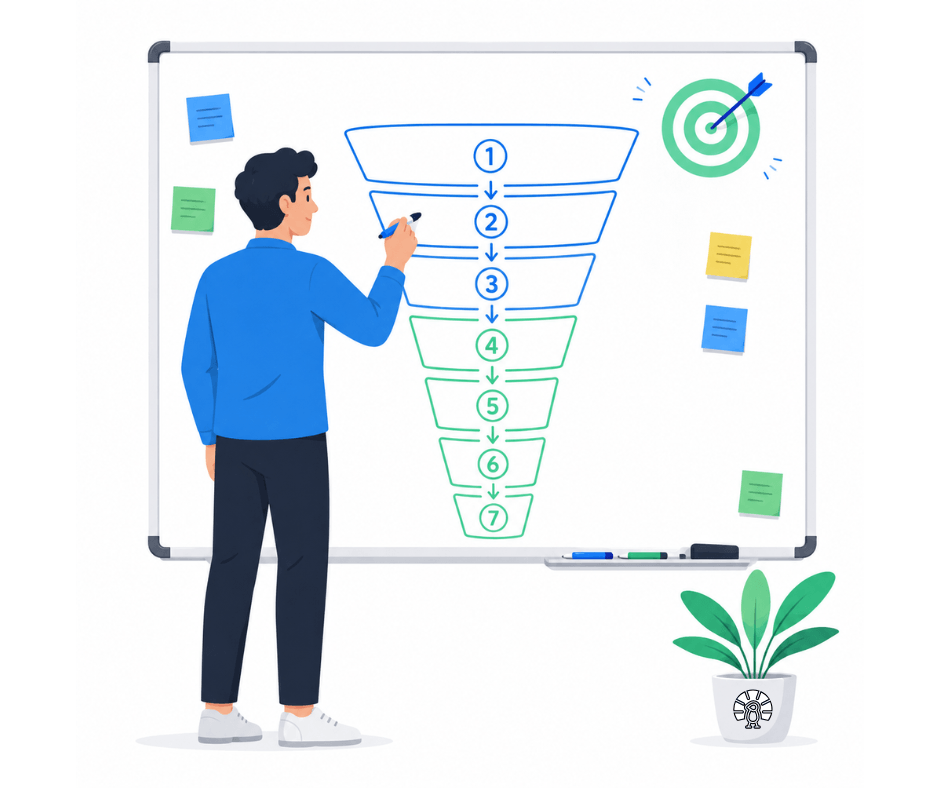
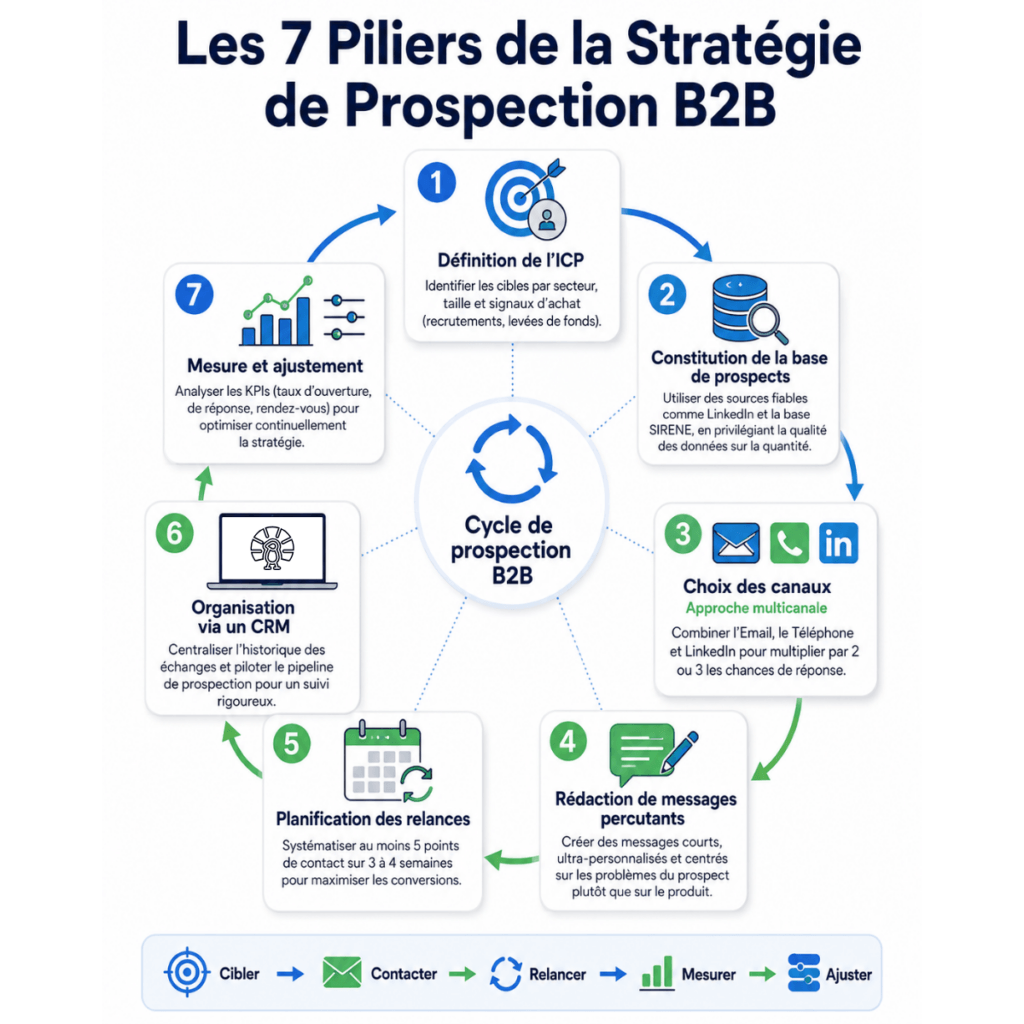
The plan does not have to be complex. Seven steps are enough to move from artisanal prospecting to a repeatable, measurable process.
Step 1: define your ICP (Ideal Customer Profile)
Before opening a list of prospects, you have to know who you are looking for. The ICP defines the characteristics of the companies most likely to buy: industry, size (headcount, revenue), geography, and buying signals (active hiring, funding round, leadership change).
A precise ICP prevents you from wasting time on unqualified accounts. If your product serves B2B SMEs of 10 to 200 employees in consulting, there is no point contacting large industrial groups or retail shops.
To build your ICP, start from your best current customers. What do they have in common? What problem were you solving for them? What triggered their decision to buy? Those answers draw the outline of your ideal target.
An ICP search tool lets you filter companies by industry, size, and region to build lists you can act on right away.
Step 2: build your prospect database
Once the ICP is defined, you need to build the list of companies and people to reach. There are several sources:
- Public business data (national registries, statistical databases): to identify companies by industry, headcount, and location
- LinkedIn: to find the decision-makers inside those companies
- Trade shows and events: for contacts met in person
- Customer referrals: for qualified introductions
The quality of the database matters far more than its size. 200 well-targeted prospects with verified data (business email, current role, confirmed employer) beat 2,000 rough contacts. Automatic company data enrichment and contact enrichment let you complete each record without manual data entry.
Step 3: choose your prospecting channels
Email, phone, LinkedIn, in-person: each channel has its strengths. The choice depends on your target and your sales cycle.
- Cold email works well at volume and for first touches. Average reply rate: 3 to 8%.
- The phone remains the most direct channel, with a conversion rate of 5 to 15% when the call is prepared.
- LinkedIn (social selling) works well for tech profiles and startups, with reply rates of 10 to 25% on direct messages.
- A multichannel approach (email + LinkedIn + phone) multiplies reply rates by 2 to 3 versus a single channel.
The common mistake is sticking to a single channel. A prospect who did not reply to an email may pick up the phone. Someone who ignores LinkedIn may open an email. Combining channels always outperforms repeating the same one.
Step 4: write your messages
An effective prospecting message follows three rules:
- Short. A prospecting email should not exceed 5 to 7 lines. A phone script fits in 30 seconds. Your prospect has no time, and a long message is an ignored message.
- Personalized. Mentioning the company name is not enough. Referencing a real problem the prospect faces, a recent event in their industry, or a shared connection with an existing customer lifts reply rates by 3 to 5 times.
- Problem-first, not product-first. The first touch is not a sales pitch. It is a question: “Do you have this problem? If so, let’s talk.” The goal is to book a meeting, not to sell.
Step 5: plan your follow-up sequences
80% of B2B sales need at least 5 touchpoints. Yet 44% of reps give up after a single attempt. Following up is not being pushy: it is the norm in B2B prospecting.
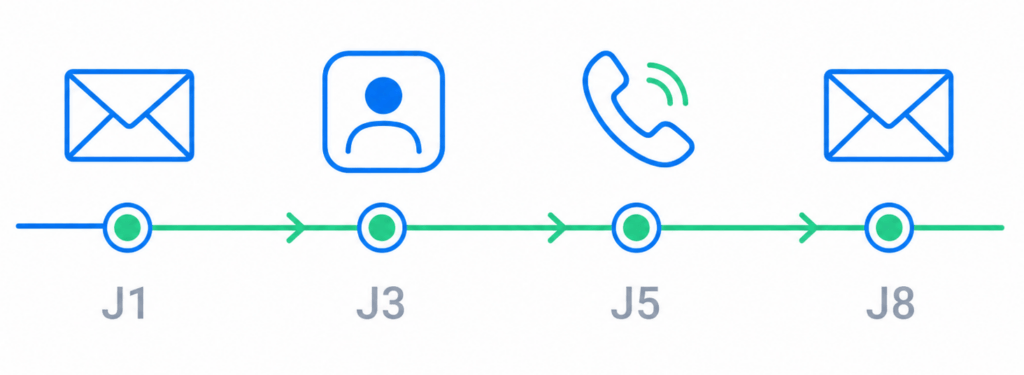
A standard email sequence includes 4 to 6 touchpoints spread over 3 to 4 weeks, rotating channels:
- Day 1: introductory email
- Day 3: LinkedIn connection request
- Day 5: phone call
- Day 8: follow-up email (new angle)
- Day 15: final follow-up email
Automating those touches with email sequences lets you schedule follow-ups without manual effort. The rep focuses on replies, not on tracking who was sent what.
Step 6: organize follow-up in a CRM
Without a system to track it, prospecting collapses as soon as you pass twenty active prospects. Who was contacted? When to follow up? Where does each opportunity stand? Those questions need an answer in 10 seconds, not by digging through emails.
A CRM centralizes everything: contact records, conversation history, prospecting pipeline, and follow-up reminders. Typical pipeline stages for prospecting are: contacted, followed up, qualified, meeting booked, proposal sent.
A CRM with native business-data enrichment avoids duplicate data entry and keeps prospect records up to date on its own. Emails attach to the right contacts without manual work, and reminders trigger without you thinking about them.
Step 7: measure and adjust
A prospecting plan without measurement is a plan that stalls. The essential metrics to track:
- Open rate (emails): below 30%, the subject line needs work
- Reply rate: below 5%, the message or the targeting has a problem
- Number of meetings booked: the ultimate measure of prospecting
- Meeting-to-customer conversion rate: if this rate is low, the issue is no longer prospecting but sales execution
Every campaign should be compared with the previous one. Which message worked best? Which channel produced the most meetings? Which segment converts best? That data guides how you adjust the plan for the next cycle.
A prospecting plan is not a static document. It is a loop: target, contact, follow up, measure, adjust, start over.
Frequently asked questions about sales prospecting plans
How many prospects do you need to contact to book one meeting?
In B2B prospecting, the average ratio is one meeting for every 15 to 25 prospects contacted. That ratio varies with the quality of your targeting and the relevance of your message. With a well-defined ICP and enriched data, you can get down to 1 meeting per 10 contacts.
How do you structure a prospecting plan when you are starting out?
Start by defining 3 criteria for your ideal customer (industry, size, location), build a list of 50 qualified prospects, write a personalized message, and plan 5 touchpoints per prospect over 3 weeks. Measure results after the first cycle and adjust from there.
What follow-up frequency is acceptable in prospecting?
In B2B, 4 to 6 touchpoints spread over 3 to 4 weeks is an effective cadence without being intrusive. Rotating channels between touches (email, LinkedIn, phone) works better than repeating the same one.
For a deeper look at B2B-specific techniques, see our guide B2B Sales Prospecting: Techniques and Best Practices. And to pick the right tools, read Sales Prospecting Tools: How to Choose.