The short version:
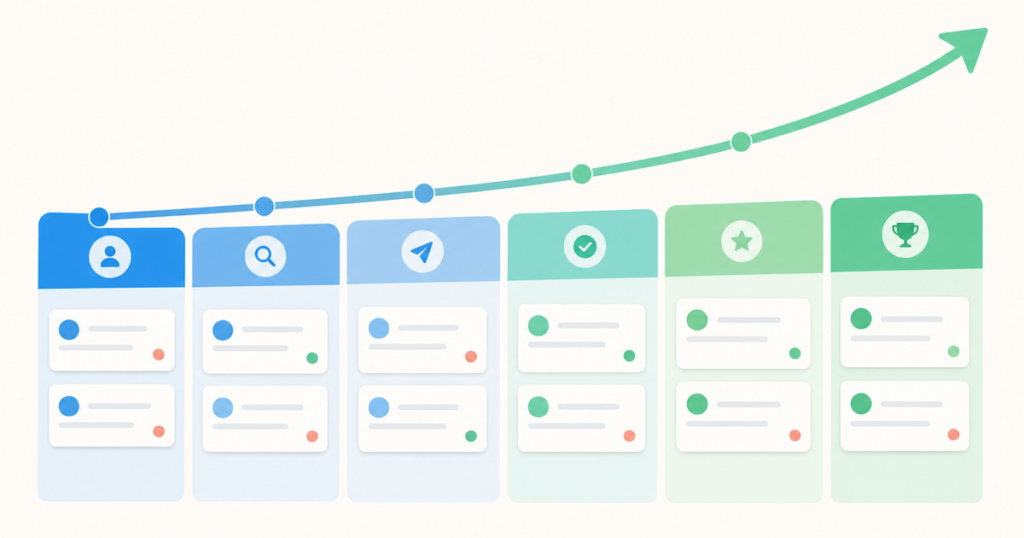
- SPANCO splits the sales cycle into six stages, from suspect to order, giving the whole team a shared vocabulary.
- Each stage maps to a pipeline column. Measuring the conversion rate between two stages shows exactly where deals get stuck.
- It is a pipeline framework, not a discovery script. Pair it with SONCAS for the pitch itself.
- Its weak spot: it assumes a linear path, whereas real B2B buying rarely moves in a straight line.
“Where are we on this deal?” On a team without a shared framework, the answer shifts depending on who you ask. The SPANCO method fixes that by naming the sales cycle stages the same way for everyone, from first contact all the way to the order.
Built by Rank Xerox, it remains one of the simplest frameworks for structuring a sales pipeline and training new reps. Here are its six stages in detail, the criteria for moving from one to the next, and how to use it to run the business, not just describe it.
The six stages of SPANCO in detail
Suspect
A company that matches your ideal customer profile but that no one has yet contacted. At this stage, the job is to target well: a hundred well-chosen suspects beat a thousand random ones. You move to the next stage as soon as a first conversation gets going.
Prospect
A suspect becomes a prospect the moment a conversation confirms interest or a possible need. The gating criterion: the contact has agreed to keep talking. Until a real need is on the table, the opportunity is still fragile.
Approach
Also called analysis. This is the discovery phase: you qualify the need, the budget, the decision-making process and the timeline. It is the most important stage, and the one that reps in a hurry cut the most corners on. A solid approach sets up everything that follows.
Negotiation
Presenting the offer, handling objections, working through the terms. You move to conclusion once the sticking points are cleared and the customer has agreed on the principle of a deal.
Conclusion
The signature, the closing. The opportunity turns into a customer. This is where the quality of the earlier work shows: a difficult close usually betrays a shaky approach two stages earlier.
Order
The order is placed and fulfilled. Onboarding, retention and upsell begin here. This stage often gets neglected, yet it is by far the most profitable: selling more to an existing customer costs far less than winning a new one.
Mapping SPANCO to your pipeline
Each SPANCO stage becomes a column in the CRM. The point is not cosmetic: once the pipeline is laid out this way, you can measure the conversion rate from one stage to the next. That is where SPANCO turns into a diagnostic tool.
Reading stage conversion rates to find the bottlenecks
If plenty of prospects move into Approach but few reach Negotiation, the problem is qualification: you are pushing deals forward that should never have entered. If Negotiation fills up but Conclusion stays empty, the closing or objection handling is what needs work. If everything stalls at the Suspect to Prospect step, targeting or the opening message is off.
Measurement turns a hunch (“the cycle is too long”) into a precise diagnosis (“deals stall between approach and negotiation”). That is what makes a sales forecast reliable: knowing the average stage conversion rates and the number of deals per stage, you can project revenue with a reasonable margin of error.
A worked example over one quarter
Take a team that pulls in 100 prospects over a quarter. 60 make it to Approach, 30 to Negotiation, 12 to Conclusion. The conversion rates are therefore 60%, 50% and 40%. If the industry benchmark for Approach to Negotiation sits around 65%, the 50% you are seeing points to a clear weakness: qualification is letting too many soft deals through. The top priority is the Approach stage, not the close.
Common mistakes with SPANCO
The first is treating the framework as a rigid funnel. A buyer can circle back, run comparisons, pause a deal for months. Forcing a deal forward because the next column looks empty distorts the forecast. The second mistake is pushing a deal through with no clear criterion: a stage moves forward on a real signal of buyer engagement, not on a rep’s optimism.
SPANCO next to newer frameworks
SPANCO is still a linear framework, built for a cycle that moves stage by stage. Today’s buying journeys are less straight. Approaches like MEDDIC focus on the fine-grained qualification of the opportunity rather than the sequence of stages. SPANCO remains useful for structuring a pipeline and training reps, as long as you do not treat it as a funnel.
SPANCO and SONCAS, two complementary methods
SPANCO tells you where you are in the cycle. SONCAS tells you how to convince once you are there. One runs the pipeline, the other argues the case. Using them together means knowing both where to push and how. Our guide to B2B sales methods shows how to layer them along the cycle.
The role of the CRM
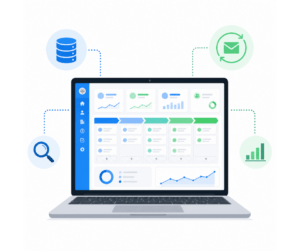
SPANCO without a tool is just theory on a whiteboard. The CRM is what turns the six stages into columns, computes the conversion rates and makes the pipeline readable at a glance. Without it, you are back to hand-kept spreadsheets that go stale fast and are never up to date when you need them.
Frequently asked questions
What is the difference between SPANCO and a standard pipeline?
A pipeline is the tool, SPANCO is a way of naming its stages. SPANCO sets a standard so the whole team speaks the same language about deal progress.
Is SPANCO outdated?
As a pipeline and training framework, no. As an accurate picture of a modern buying journey, it shows its limits: real purchases are not linear. Use it as a compass, not as a funnel.
How many stages should a pipeline have?
The six SPANCO stages are a good starting point. Many small and midsize businesses keep four or five by merging the earliest ones. What matters is that each stage reflects a real shift in buyer engagement.
How do you set the criterion for moving from one stage to the next?
Every step should rest on an observable fact, not a gut feel: a meeting booked, a need clearly stated, an offer accepted in principle. Writing these criteria down in black and white keeps each rep from advancing deals on personal mood.
Does SPANCO work for short sales cycles?
Yes, in a lighter version. On a short cycle, Approach and Negotiation often overlap. The framework is still useful for pinpointing where deals are lost.
Which method should you use to qualify during the Approach stage?
That is where BANT or MEDDIC come in. SPANCO places the deal within the cycle, while these methods structure the qualification of need, budget and decision-making process during the approach phase.