The Social Selling Index, often shortened to SSI, is a metric created by LinkedIn to measure how you use the platform for social selling. In practice, LinkedIn gives you a score out of 100 to assess your ability to build your professional brand, find the right people, engage with relevant content and grow trusted relationships.
Long considered a benchmark for salespeople active on LinkedIn, the social selling index is still useful today for tracking a few good habits. But it should be read with a bit of distance: LinkedIn itself points out that a high score does not always translate into real sales effectiveness or concrete results.
What is the Social Selling Index?
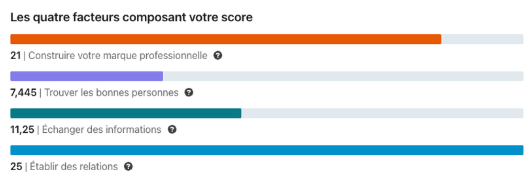
The LinkedIn Social Selling Index is a score from 0 to 100, split into four pillars of 25 points each. Its goal is to help you understand whether you are using LinkedIn effectively for prospecting, professional visibility and relationship building. LinkedIn also lets you compare your social selling index to your network and to your industry peers.
The four pillars of the Social Selling Index
1. Establish your professional brand
Here LinkedIn evaluates the quality of your professional presence. This comes down to profile strength, multimedia content, cover photo, recommendations, long-form posts and follower growth.
2. Find the right people
This pillar of the social selling index measures your ability to target the right prospects using the search features. LinkedIn cites people search, advanced searches, saved leads, profile views and how consistently active you are.
3. Engage with insights
The SSI factors in how you discover, share and use relevant information to start conversations. LinkedIn points to inbound and outbound interactions, shares, participation on long-form posts, messages sent, InMail response rate, group membership and a few profile-view signals.
4. Build strong relationships
Finally, LinkedIn looks at how well you grow a trusted network. That includes your connections, links with decision-makers, internal relationships and your invitation acceptance rate.
What is a good SSI score?
There is no official threshold, but here are the benchmarks commonly seen in B2B:
- Below 40: low activity on LinkedIn. Your network isn’t working for you. This is the typical score for a profile that was created but never maintained.
- Between 40 and 60: regular but unstructured use. You post from time to time, you accept connections, but without any targeting strategy.
- Between 60 and 75: good level. You use LinkedIn methodically: targeting, content, interactions. That’s the average score for salespeople actively doing social selling.
- Above 75: excellent. You are in the top 10% of your industry. Careful though: a high score does not guarantee sales results. What matters is what you do with the conversations it generates.
LinkedIn shows your ranking within your industry and your network directly in the SSI dashboard. That is often more useful than the absolute score: an SSI of 55 in an industry where the average is 30 is more meaningful than an SSI of 70 in an industry where everyone posts constantly.
SSI and company size: what changes
In large companies, salespeople often have access to LinkedIn Sales Navigator, which mechanically boosts the “Find the right people” and “Build relationships” pillars. In an SMB without Sales Navigator, reaching an SSI above 70 takes more effort on content and interactions. That is normal: the resources are not the same, but the good habits stay identical.
How to check your Social Selling Index on LinkedIn
LinkedIn has made the social selling index available to everyone through a dedicated dashboard. That dashboard lets you understand your level, see the breakdown across the four pillars, follow how they evolve over time and see where you stand compared to your industry and your network.
Is the Social Selling Index still useful in 2026?
Yes, but not for the same reasons as before.
The social selling index is still useful as a behavioral indicator: it helps you see whether you have a credible profile, whether you target your prospects better, whether you share useful content and whether you actually maintain your network.
However, LinkedIn now clearly points out that a high SSI score does not always reflect real sales effectiveness. A strong score can even distract salespeople from the essentials: better targeting, better personalization, real conversations and closing deals.
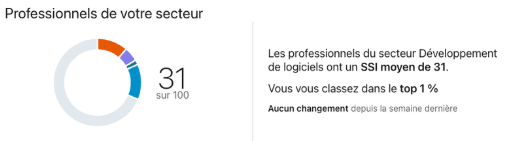
The right approach is to treat the social selling index as a thermometer of LinkedIn usage, not as a final business KPI. Your real indicators remain the conversations you get, the qualified meetings and the opportunities created, in short the fundamental sales activity.
How to improve your Social Selling Index
To improve your social selling index, work on each pillar methodically.
Optimize your LinkedIn profile
Make your profile more complete and more credible: banner, customer-focused summary, multimedia elements, recommendations and content published regularly. A profile filled out “just to look tidy” is not enough. It should clearly show who you help, how, and on which topics you have real legitimacy.
Target your prospects better
Use LinkedIn as a targeting tool, not just a directory. Combine it with an ICP search tool to identify companies that truly match your target. Advanced searches, profiles viewed in a consistent way, saved leads and steady activity are all signals LinkedIn factors into your social selling index.
Share useful and engaging content
Your SSI does not go up just because you post often. What counts is the relevance of your interactions: useful shares, exchanges, participation in conversations and the ability to spark engagement on topics that matter to your target market.
Work on the relationship, not just the audience
A strong social selling index also relies on the quality of your network: ties with decision-makers, invitations accepted, conversations kept alive over time. Social selling is not about piling up contacts. It’s about the ability to build trust.
Social selling and sales prospecting: the winning combination
Social selling on LinkedIn doesn’t work in isolation. The best results come when it’s part of a broader sales prospecting approach, combined with other channels.
LinkedIn + email + phone: the multichannel sequence
An approach that works in B2B: engage on LinkedIn (profile view, comment, connection), then send a personalized cold email a few days later, and finally call while referencing the previous exchanges. This multichannel sequence produces response rates 2 to 3 times higher than a single channel.
SSI as an activity indicator, CRM as a results indicator
The social selling index measures your activity on LinkedIn. But it’s the meetings booked and the deals closed that count. A CRM lets you connect the two: which prospects contacted through LinkedIn turned into a meeting? What is the conversion rate of social selling compared to other channels?
Without that tracking, you improve your SSI without knowing whether it actually produces results. With a CRM that centralizes interactions (emails, calls, notes) and follows the pipeline, you measure the real impact of social selling on revenue.
Enrich the contacts you find on LinkedIn
LinkedIn is a great tool for identifying prospects. But to reach out effectively, you often need more than a LinkedIn message: a verified professional email, a direct phone number, information about the company. Contact enrichment takes you from “I found the right profile on LinkedIn” to “I have their email, their current role and their company data inside my CRM”.
The limits of the Social Selling Index
The main risk with the social selling index is turning it into a goal in itself. LinkedIn stresses that the sales landscape has shifted: a high score guarantees neither commercial relevance, nor pipeline, nor closing.
A salesperson can have a high SSI and few results, just as another can have an average social selling index and excellent closing skills. The SSI is useful for shaping habits on LinkedIn, but not enough to judge overall sales performance.
I’ll add that personally I’d take off 1000 points from anyone who asks you to comment “deal” to receive by DM the ultimate guide to who knows what. But that’s just my opinion.
Frequently asked questions about the Social Selling Index
How do I check my Social Selling Index?
Log in to LinkedIn and go to linkedin.com/sales/ssi. Your score shows up right away along with the breakdown of the four pillars, your ranking in your industry and in your network. No need for Sales Navigator: the SSI dashboard is free and open to all LinkedIn accounts.
Does the SSI influence the reach of my LinkedIn posts?
LinkedIn has never officially confirmed that the SSI directly impacts the algorithm that distributes posts. That said, the behaviors that improve the SSI (posting regularly, engaging, having a complete profile) are also the ones that improve organic reach. It’s not the score that boosts visibility, it’s the underlying habits.
How often is the Social Selling Index updated?
LinkedIn updates the SSI daily. Changes reflect your activity over the past few weeks. A period of inactivity brings the score down gradually, while resuming activity brings it back up within a few days.
Can you have a strong SSI without LinkedIn Sales Navigator?
Yes. Sales Navigator mainly helps on the “Find the right people” pillar thanks to advanced filters. But the three other pillars (professional brand, interactions, relationships) don’t depend on Sales Navigator. A complete profile, relevant content and regular interactions are enough to reach an SSI of 60 to 70 without a paid subscription.
How can I use SSI to manage a sales team?
The SSI is useful as an indicator of LinkedIn adoption within the team. If a rep has an SSI of 20, they’re not using LinkedIn. If another one is at 70, they’re active. The SSI helps identify who needs coaching. But it should never become an individual target: a salesperson who spends the day optimizing their SSI instead of prospecting produces nothing.
Conclusion
The Social Selling Index is still a relevant metric for anyone using LinkedIn to prospect, build visibility or grow a professional network. It helps you visualize the four pillars of social selling and identify concrete areas of improvement.
But an up-to-date article should say it clearly: the social selling index is a steering tool, not an end goal. The objective is not to raise a score for its own sake, but to use LinkedIn more intelligently to build better business relationships and generate real opportunities. To structure your whole approach beyond LinkedIn, take a look at our sales prospecting guide.