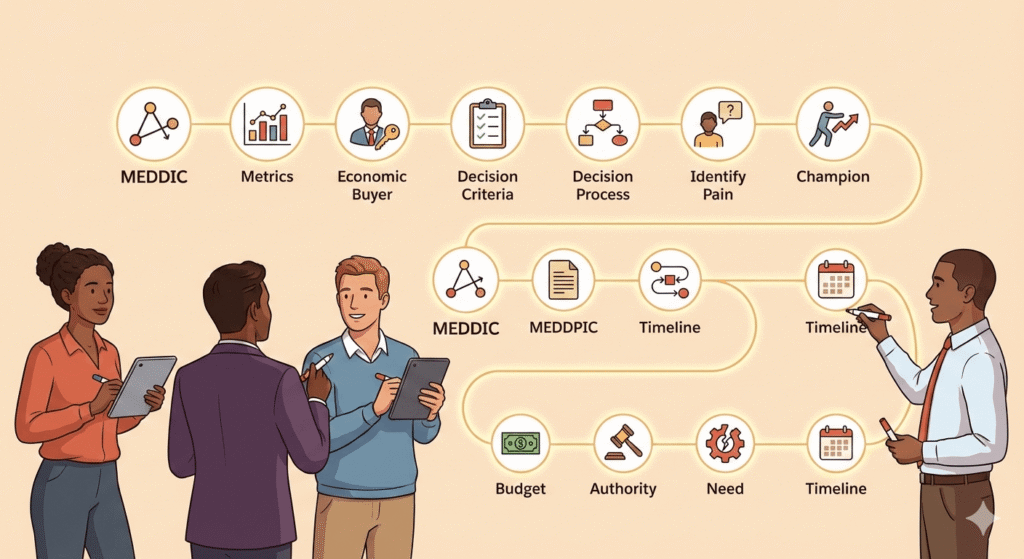
The short version:
- MEDDIC, MEDDPIC and BANT are three sales qualification methods built for very different selling contexts.
- BANT fits short cycles and high lead volume. MEDDIC brings structure to complex sales. MEDDPIC adds the procurement and legal dimension for enterprise accounts.
- The right choice is not about what is trendy. It is about the real complexity of your sales cycle, the number of decision-makers involved and the volume of leads to process.
Why structured qualification matters
Every sales team qualifies its prospects. What varies is how rigorous the process is. Without a shared method, each rep qualifies their own way, with their own biases and shortcuts. The result is a pipeline stuffed with fragile opportunities, an unreliable forecast, and a huge amount of time wasted on prospects that will never close.
A qualification method delivers three concrete benefits. It aligns the vocabulary reps use, which makes pipeline reviews readable. It forces the right questions early, which weeds out deals that will not sign. And it produces a more predictable forecast, which changes how you steer the business.
Three methods dominate B2B practice in 2026: MEDDIC, MEDDPIC and BANT. Each one matches a different kind of sale. Choosing between them is not a matter of preference, it is a matter of fit with your actual sales cycle.
MEDDIC: the reference method for complex sales
MEDDIC was born in the 1990s at PTC (Parametric Technology Corporation), a CAD software vendor. It has since become the standard qualification framework for complex B2B sales, especially in SaaS, industrial goods and business services.
What the MEDDIC acronym stands for
MEDDIC is a six-letter acronym. Each letter maps to a dimension you need to investigate to qualify a deal seriously:
- M for Metrics: what does success look like for the buyer? How much money, time or productivity does your solution need to deliver to justify the purchase?
- E for Economic Buyer: who holds the final call on budget? Not the project lead, not the end user, but the person who actually signs.
- D for Decision Criteria: what objective criteria will the decision rest on? Price, features, integrations, support, references.
- D for Decision Process: how does the decision actually get made? How many steps, which approvals, which committees.
- I for Identify Pain: what specific problem does your solution solve? What is the cost of that problem to the customer today?
- C for Champion: who inside the account is carrying the project internally and will defend it when you are not in the room?
When to use MEDDIC
MEDDIC makes sense when the sales cycle runs beyond three months, when the deal size justifies a real investment of time (typically above 20,000 EUR per contract), and when at least three stakeholders are involved on the buyer side. Below those thresholds, the method becomes heavy relative to the payoff.
It is the go-to method for B2B software vendors, business services firms, industrial manufacturers and any player whose sales require a consultative approach.
MEDDPIC: MEDDIC plus the Paper Process
MEDDPIC is a more recent evolution of MEDDIC, popularised in the 2010s by SaaS vendors with long sales cycles (Snowflake, Salesforce, Workday). It adds one letter, the P for Paper Process, and that letter changes the end of the cycle significantly.
What the P actually adds
The Paper Process is the administrative and contractual work that sits between the verbal agreement and the actual signature. In large organisations, this can take several weeks or several months: legal review, procurement committee, compliance, e-signature, purchase orders, vendor onboarding.
Plenty of deals move all the way to a solid verbal yes and then stall on the Paper Process. Reps discover too late that this account needs eight weeks to countersign a contract, or that compliance will not accept the standard terms. The P in MEDDPIC forces you to handle this early, not at the finish line.
MEDDPIC therefore covers seven dimensions: Metrics, Economic Buyer, Decision Criteria, Decision Process, Paper Process, Identify Pain, Champion.
When to use MEDDPIC
MEDDPIC becomes essential the moment you sell to organisations with more than 500 employees, to public bodies, or in regulated sectors (banking, insurance, healthcare, defence). If your reps often hear “we are aligned, we just have to sign” and the deal then drags for another three months, that is the signal to move to MEDDPIC.
BANT: fast qualification for short cycles
BANT is the oldest of the three, created by IBM in the 1960s. It is still widely used today, precisely because it is simple and quick to run.
What BANT measures
BANT focuses on four core qualification criteria:
- B for Budget: does the prospect have a budget for this purchase? What order of magnitude?
- A for Authority: does the person you are talking to have the authority to decide? If not, who does?
- N for Need: is the need real and identified, or is this a vague exploration?
- T for Timing: on what horizon does the decision need to be made?
BANT follows a simple logic: if any of the four boxes is empty, the deal is not qualified and does not deserve sustained sales effort.
When to use BANT
BANT shines in high-volume, short-cycle contexts. It is the right method for SDRs (Sales Development Representatives) who qualify dozens of leads a day, for transactional deals under 5,000 EUR per contract, and for inbound models where the goal is to sort interested prospects from tyre-kickers quickly.
BANT is not fit for complex sales: on a 100,000 EUR deal involving five decision-makers, knowing there is budget and authority is not enough. You need to dig much deeper.
MEDDIC, MEDDPIC, BANT: quick comparison
| Criterion | BANT | MEDDIC | MEDDPIC |
|---|---|---|---|
| Origin | IBM, 1960s | PTC, 1990s | SaaS, 2010s |
| Number of dimensions | 4 | 6 | 7 |
| Cycle length it fits | Short (days, weeks) | Long (months) | Very long (quarters) |
| Typical deal size | Under 5,000 EUR | 20,000 EUR and up | 50,000 EUR and up |
| Number of decision-makers | 1 to 2 | 3 to 5 | 5 and up |
| Target role | SDR, inbound sales | Account Executive, complex sales | Enterprise Account Executive, key accounts |
| Qualification effort | Light (15 min) | Medium (1 to 2 hours) | Heavy (several meetings) |
How to pick the right method for your team
Four simple questions settle the debate.
1. What is the median size of the deals you close? Under 5,000 EUR, BANT is enough. Between 5,000 EUR and 50,000 EUR, MEDDIC brings the depth you need. Above 50,000 EUR with large accounts, MEDDPIC is a must if you do not want the Paper Process to blindside you.
2. How many people are usually involved in a decision? One or two: BANT. Three to five: MEDDIC. Five or more with buying committees: MEDDPIC.
3. How long is your average sales cycle? Under 30 days: BANT. One to six months: MEDDIC. More than six months: MEDDPIC.
4. How often do your deals stall on contractual or administrative issues at the end of the cycle? Often: MEDDPIC, no hesitation.
Many sales teams actually run two methods in parallel. BANT as the first filter at the SDR level, then MEDDIC or MEDDPIC for deeper qualification handled by Account Executives.
Rolling out a qualification method inside your team
Adopting MEDDIC, MEDDPIC or BANT is not about printing an acronym on the wall. It is a process change, and it needs discipline.
- Capture every dimension in the CRM. If the method lives in the reps’ heads, it will not be applied. Every MEDDIC dimension or BANT criterion needs a dedicated field on the deal record.
- Make qualification a pipeline gate. A deal only moves into the “Discovery” stage once qualification is filled in. Without that gate, the method gets ignored.
- Coach during pipeline reviews. In weekly one-on-ones, the manager runs through the method’s questions for every major deal. Blind spots surface fast.
- Measure the impact. Track the win rate of qualified deals versus non-qualified ones. The gap is usually striking after three months.
Qualification methods and the right tooling
A good CRM makes qualification methods stick by offering structured fields, customisable deal templates and dashboards broken down by qualification stage. Without that support, reps route around the method to save time, and you drift back to gut-feel qualification.
The ideal setup is a CRM that lets you define your own qualification dimensions (the six of MEDDIC, the seven of MEDDPIC, the four of BANT) and can block a deal from moving forward until the critical fields are complete. That is what turns a theoretical method into a real sales practice.
Frequently asked questions about MEDDIC, MEDDPIC and BANT
What is the difference between MEDDIC and MEDDPIC?
MEDDPIC is an extension of MEDDIC that adds a P for Paper Process. This dimension covers the administrative and contractual work at the end of the cycle (legal review, procurement committee, signature process). MEDDPIC is useful in enterprise sales where the contracting phase can take several weeks.
Is BANT still relevant in 2026?
Yes, on a specific scope. BANT remains the most effective method for quickly qualifying a large volume of leads on short cycles. It is still used by most B2B SDR teams. That said, it falls short on complex sales, where you need to investigate far more than four dimensions.
Can you combine MEDDIC and BANT?
Yes, and it is common practice in well-structured teams. BANT works as the initial filter applied by SDRs on inbound leads. Once a lead clears the four BANT dimensions, it is handed off to the Account Executive, who takes over with MEDDIC or MEDDPIC for deeper qualification.
Is MEDDIC suitable for SMBs?
Yes, as long as you do not over-apply it. An SMB selling to other SMBs can use MEDDIC on strategic deals (above 15,000 EUR) without running it on every small deal. Simple rule: MEDDIC for deals that justify two hours of sales investigation, BANT for the rest.
How do you know you have really identified the Champion in MEDDIC?
Three signs confirm a real Champion. They defend your solution internally when you are not there. They share strategic information you would not have got otherwise (deadlines, competitors, detractors). They agree to introduce you to the Economic Buyer without hesitation. If those three are not all in place, what you have is a friendly contact, not a Champion.
Which method should a new rep start with?
BANT, because it is easy to learn, then a gradual move to MEDDIC on more complex deals. Trying to apply MEDDIC or MEDDPIC from day one is usually counterproductive: a junior rep will get lost in the dimensions without knowing which ones to prioritise. BANT builds the qualification reflex first, the rest comes with experience.