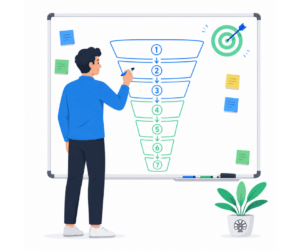
The short version:
- A sales methodology exists to make what works repeatable, so results no longer depend on the raw talent of one rep.
- No single method covers everything. Most teams combine two or three: one to qualify, one to run the conversation, one to steer the cycle.
- A CRM is what turns a framework pinned to the wall into one actually used every day, because it makes the method visible at every stage of the pipeline.
Ask ten sales reps how they sell. You will get ten different answers, and most of them will start with “it depends”. That is not a flaw. B2B selling is a context game. But without a shared framework, a team never really improves: everyone reinvents their own playbook, nothing gets passed on, and the good results stay attached to two or three people.
Sales methodologies exist for that reason. They provide a shared vocabulary, named stages, and the right questions to ask at the right time. They do not replace listening or experience, they give them structure. Here are the main frameworks used by B2B sales teams today, what they really deliver, and how to pick the ones that fit your business.
Why adopt a method instead of winging it
A strong seller with no method is still a strong seller. A team with no method is just a collection of individuals. The gap shows up when you hire, onboard someone new, or try to understand why a quarter fell short.
A methodology delivers three concrete things. It makes performance analyzable: you can see exactly where deals stall. It speeds up ramp: a junior follows a framework instead of feeling their way for six months. And it makes forecasting reliable, because a sales cycle broken into clear stages can be measured, while a pipeline run on gut feel cannot.
The good news is that you never start from scratch. A handful of proven frameworks cover most B2B situations. The work is to know them, then to choose.
Qualification frameworks: BANT and MEDDIC
Qualifying means deciding early whether a prospect deserves your time. It is the first sales discipline, and the one that saves the most time when you actually stick to it.
BANT is the simplest: budget, authority, need, timing. Four questions to sort fast. It fits short cycles and high volumes, typically outbound prospecting where a team is processing a lot of leads.
MEDDIC goes further, for complex sales with multiple stakeholders: metrics, economic buyer, decision criteria, decision process, identify pain, champion. More demanding, more reliable on larger deals. Choosing between the two comes down to the size and length of your opportunities. We covered the full comparison in our dedicated article, MEDDIC, MEDDPIC and BANT for your sales team.
SPIN Selling: the art of asking the right questions
Where BANT and MEDDIC sort, SPIN sheds light on why a buyer would move. Built by Neil Rackham on the back of 35,000 recorded calls, the framework lays out four kinds of questions: Situation, Problem, Implication, Need-payoff. You start with context, uncover a real problem, make the buyer feel its cost, then let them articulate the value of solving it.
What SPIN really changes is the balance of the meeting. Instead of pitching features, the rep asks questions that lead the buyer to draw their own conclusions. It works especially well in consultative sales, where the customer has to be convinced they even have a problem worth solving. It is one of the most widely taught methods on B2B sales floors.
The Challenger Sale: teach, tailor, take control
The Challenger Sale, from CEB’s research on high performers, argues that the best reps in complex B2B are not the relationship builders but the Challengers. Their signature move is three-part: teach the customer something new about their own business, tailor the message to the specific stakeholder, and take control of the conversation, including on pricing.
Challenger fits environments where the buyer is drowning in vendors saying the same thing, and where a fresh point of view is what breaks the tie. It requires reps who can hold a strong opinion in front of a decision maker, which is harder to hire and to train than it sounds. Used well, it shortens cycles by reframing the buying decision itself.
Solution and Value Selling: sell outcomes, not features
Solution Selling and its more recent cousin, Value Selling, share the same starting point: nobody buys a product, they buy a result. The rep’s job is to map the customer’s pain to a measurable outcome, then price that outcome, not the tool that delivers it.
In practice, this means less time on demos and more time quantifying impact: hours saved, revenue unlocked, risk avoided. It fits software and services where the ROI story is what unlocks budget. It also fits any deal that has to survive a finance review, since the case is already built in the customer’s own numbers.
SPANCO: steering the cycle from first touch to signature
SPANCO is not about the conversation, it is about the path: Suspect, Prospect, Analysis, Negotiation, Conclusion, Order. Six stages that describe how a deal moves through the pipeline.
Its value is getting everyone to agree on where a given deal actually stands. When every rep names the stages the same way, the pipeline becomes readable, forecasts hold up, and blockers stand out. SPANCO is less an interview technique and more a language for pipeline management. It pairs well with the conversation-level methods above: one tells you where you are, the other tells you how to move forward.
Sandler and Gap Selling: modern classics worth knowing
The Sandler method flips the traditional dynamic. Instead of chasing the prospect, the rep qualifies hard and out early: no budget, no next step, no polite second meeting. Built around an upfront contract at the start of every call, it kills the “think it over” phase that clogs so many pipelines.
Gap Selling, from Keenan, sits close to Solution Selling but insists on one thing: measure the gap between the customer’s current state and their desired future state. Everything else, the demo, the pricing, the proposal, hangs off that gap. If the rep cannot describe it in numbers, the deal is not qualified.
Which methodology to choose for your context
These frameworks do not compete with each other, they stack. Here is how to place them.
| Need | Framework | When to use it |
|---|---|---|
| Sort leads fast | BANT | Short cycles, high volume |
| De-risk a large deal | MEDDIC | Complex sales, multiple decision makers |
| Uncover real needs | SPIN Selling | Consultative sales, unaware buyers |
| Reframe the buyer’s thinking | Challenger Sale | Crowded markets, commoditized offers |
| Sell business outcomes | Solution / Value Selling | Deals that need a finance-grade ROI case |
| Steer the pipeline | SPANCO | Opportunity tracking, forecasting |
| Qualify out ruthlessly | Sandler | Overloaded pipelines, wasted meetings |
A common stack inside a modern B2B team: BANT to qualify upfront, SPIN or Challenger to run the meeting, Value Selling to write the proposal, SPANCO to track the pipeline, MEDDIC to close the ones that really matter. Five frameworks, one thread. No need to adopt them all at once. Start with qualification and pipeline management, the rest follows with practice.
The CRM: what keeps a methodology alive
A framework unveiled in a kickoff meeting and forgotten the next day is worthless. What holds it together is the tool that makes it visible day after day. A well-configured CRM maps SPANCO stages onto the pipeline, records the SPIN or MEDDIC signals the rep uncovered, and prompts the next action on every deal.
That is where a methodology moves from talk to habit. Without a CRM, it depends on individual memory and discipline. With a CRM built around the sales team, it becomes the default reflex across the whole team: a readable pipeline, records that fill themselves without drudgery, and the team’s playbook embedded in the tool rather than pinned to a whiteboard.
Frequently asked questions
What is the best B2B sales methodology?
There is no single winner. The best combination depends on your sales cycle. For simple, fast deals, BANT plus SPIN is usually enough. For complex ones, MEDDIC gives qualification a sharper edge, and Challenger reframes the buyer’s thinking. SPANCO layers on top of any of them for pipeline tracking.
SPIN Selling vs Challenger Sale, what is the difference?
SPIN leads the buyer to their own conclusion through a chain of questions. Challenger takes the opposite tack: the rep brings a strong point of view and pushes the buyer to see their situation differently. SPIN suits consultative sales, Challenger suits crowded markets where a fresh angle wins the deal.
Do these methods work for a small sales team?
Yes, and that is where they pay off the most. In a team of two to fifty reps, a shared framework prevents know-how from living only in one person’s head. There is no need to deploy them all: two well-run methods beat five that everyone only half-uses.
Do you need a CRM to apply a sales methodology?
Not to learn it, but to sustain it. A CRM makes the stages visible and the follow-up actions automatic. Without one, adoption depends on individual discipline, which erodes as soon as activity picks up.
How long does it take a team to adopt a methodology?
Count one to three months for a framework to turn into a reflex, provided it is embedded in the CRM and reinforced in pipeline reviews. A method you do not measure is a method you eventually drop.