B2B sales prospecting has almost nothing in common with consumer prospecting. Sales cycles run longer, decision-makers are harder to reach, and every touchpoint needs to be personalized. On the flip side, a single account can be worth thousands of euros in annual revenue.
This guide covers the B2B prospecting techniques that actually work for French SMBs in 2026, the mistakes that quietly kill results, and the metrics you need to measure how effective your outreach really is.
What makes B2B prospecting different
Long decision cycles
In B2C, the buying decision takes a few minutes or a few days. In B2B, it takes weeks, sometimes months. Budgets need approval, decision-makers need convincing, and competitors need to be compared. B2B sales prospecting has to factor this in: the first touch is only the start of a long process.
Multiple stakeholders to manage
You rarely deal with a single decision-maker in a B2B sale. There is usually a champion (the person who spots the need), an influencer (the one comparing the options), a signer (the one who inks the deal), and sometimes a gatekeeper who controls access. Figuring out who plays which role is step one of any effective prospecting effort.
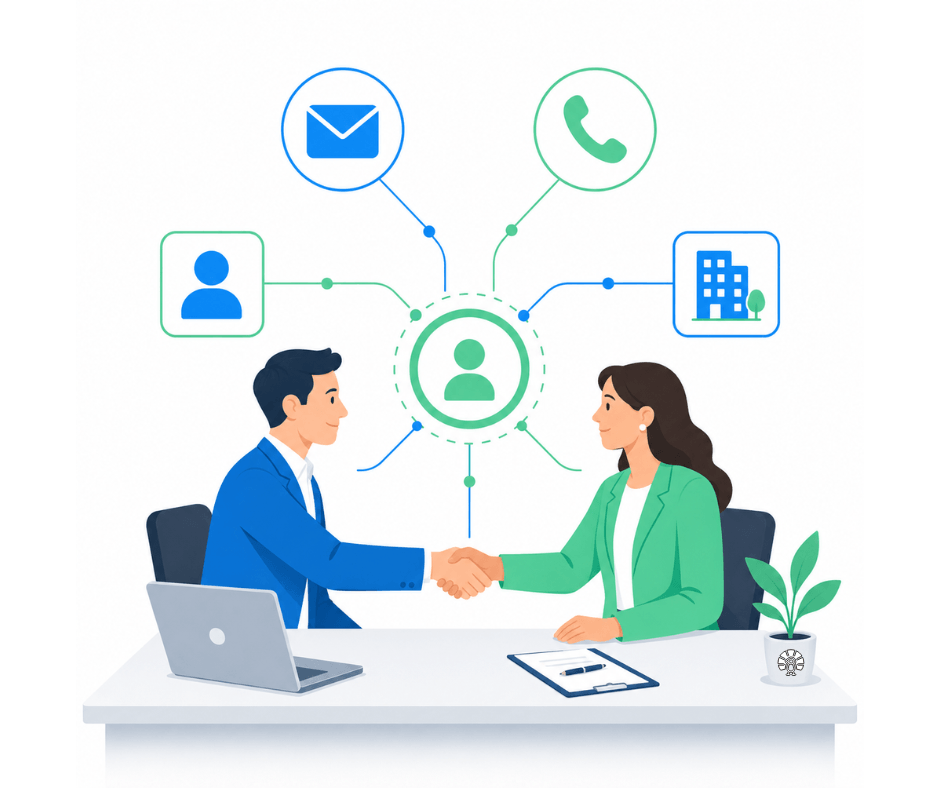
This is also why a CRM that can link contacts to each other (and not only to a company) becomes a real advantage: you can map out the relationships between the decision-maker, the champion and the end user inside the same account.
Personalization is not optional
A generic message blasted to 100,000 people in B2C can still produce results through sheer volume. In B2B, the volume is capped (a few hundred or a few thousand targets), and every contact expects a minimum of relevance. The message needs to show you understand the industry, the role and the challenges the prospect is dealing with. Without personalization, B2B prospecting is just noise.
The 5 B2B prospecting techniques that work in 2026
1. Targeted cold email
Cold email is still the most scalable channel in B2B. But it only works with tight targeting and a personalized message. Mass, untargeted emails land in spam. A good cold email calls out a concrete problem the prospect is facing, offers an angle of value, and proposes a simple next step.
The average reply rate on a B2B cold email sits between 3 and 8 percent. With strict ICP targeting and solid data enrichment (a verified work email, a confirmed current job title), that rate can climb to 10 to 15 percent.
2. Social selling on LinkedIn
Social selling means using LinkedIn to warm up conversations with prospects before reaching out directly. Post relevant content, comment on your targets’ posts, then send a personalized message. This approach takes time but delivers reply rates of 10 to 25 percent on direct messages.
Social selling works especially well for tech profiles, startups and companies where decision-makers are active on LinkedIn.
3. Prepared cold calling
The unprepared cold call is dead. The prepared call is more alive than ever. The difference: before dialing, you know who the person is, what their role is, what their company is dealing with, and why you are calling them right now (an ongoing hire, industry news, an intro from a mutual contact).
A prepared call converts at 5 to 15 percent, against less than 2 percent for a fully cold one. Preparation makes all the difference.
4. Buying signals
Certain events in a company’s life signal a good moment to reach out: hiring a head of sales (the budget is coming), raising a funding round (the money is there), moving offices (the company is growing), a change at the top (priorities are shifting).
Spotting those signals and reaching out at the right time turns a cold call into a relevant one. Picking up on hiring signals is one of the strongest levers you have for finding the right moment.
5. Customer referrals
The most under-used channel in B2B. Asking a happy customer to refer a contact produces conversion rates of 30 to 50 percent, because trust is already there. Referral prospecting does not happen on its own: you have to ask systematically, with every satisfied customer, and track the referrals in your CRM.
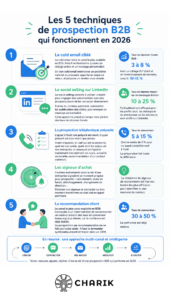
The multichannel approach: combining channels for better results
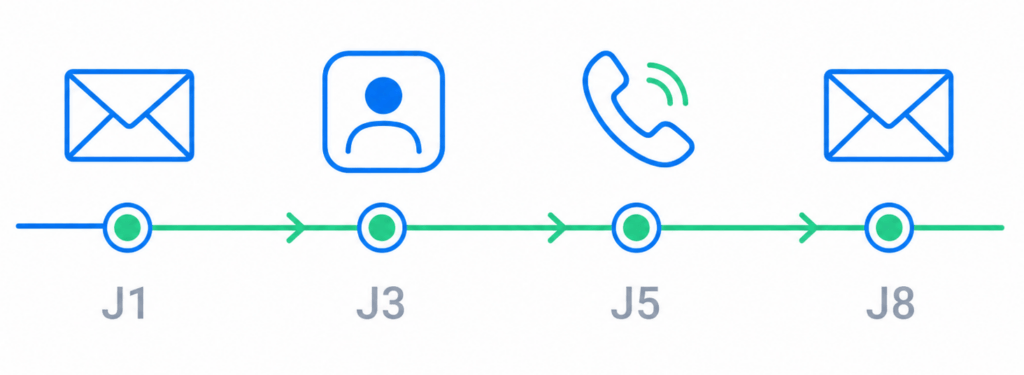
Single-channel prospecting (all email, or all phone) has clear limits. A multichannel approach layers several channels into a coordinated sequence:
- Day 1: personalized intro email
- Day 3: LinkedIn connection request with a personalized note
- Day 5: phone call (mentioning the email you sent)
- Day 8: follow-up email with a fresh angle (case study, relevant article)
- Day 15: final email (relaxed tone, open-ended question)
This sequence multiplies touchpoints without feeling pushy, because each channel brings a different format. Reply rates on multichannel sequences are 2 to 3 times higher than single-channel outreach.
Email sequence tools let you automate this cadence for dozens or hundreds of prospects in parallel.
How to identify the right B2B prospects
Targeting quality drives 80 percent of prospecting success. Reaching the right people with an average message beats reaching everyone with a great one.
Start with company data. In France, the SIRENE database and public sources (INSEE, INPI) let you filter companies by industry code, headcount, revenue and location. Automatic company data enrichment keeps those records current with the latest information.
Find the decision-makers. Once you have targeted the companies, you need to find the right person: head of sales, CEO, head of purchasing. Contact enrichment gives you the verified work email, the current job title and the LinkedIn profile. ICP search lets you filter by role and industry.
A B2B CRM with native enrichment of French data lets you do all of this from a single place: identify the company, find the decision-maker, enrich their details, and launch the outreach sequence.
The mistakes that kill B2B prospecting in SMBs
Buying unqualified databases
Bulk-purchased lists have a validity rate of 40 to 60 percent. More than half of the emails bounce, which tanks your sending domain’s reputation. You are better off building your own list with enriched, verified data.
Sending the same message to everyone
There is no universal message in B2B. The CEO of an industrial SMB and a startup’s head of marketing do not share the same problems. Segmenting your list and personalizing the message per segment is the bare minimum. Personalizing per company is the goal.
Not tracking your follow-ups
Send an email, move on to the next prospect. That is the most common way to waste prospecting effort. Without structured follow-up tracking (dates, channels, content), most opportunities slip through the cracks.
Prospecting without a CRM
An Excel file with names and emails is not a prospecting tool. It is an address book. A CRM centralizes contacts, logs every exchange, schedules reminders and measures results. Without a CRM, B2B prospecting is stuck at the artisanal stage.
Measuring B2B prospecting performance
The essential metrics for running B2B sales prospecting:
- Email open rate: target > 40 percent. Under 30 percent, the subject line needs work.
- Reply rate: target > 5 percent. Under 3 percent, the message or the targeting is the problem.
- Meetings booked per week: the outcome metric. A full-time B2B rep with a structured approach should be generating 5 to 10 meetings a week.
- Meeting-to-customer conversion rate: measures the quality of upstream targeting. A healthy ratio is 20 to 30 percent.
- Customer acquisition cost: time spent plus tools used, divided by the number of customers won.
These numbers should be reviewed every week and compared cycle to cycle. Without measurement, you do not know what is working, and you keep making the same mistakes.
Frequently asked questions on B2B sales prospecting
What is the difference between B2B and B2C prospecting?
B2B prospecting targets companies, with long decision cycles (multiple stakeholders, budgets to approve), higher average deal sizes and an ongoing commercial relationship. B2C prospecting targets individuals, with faster decisions, larger volumes and less personalization.
Is cold email legal in France for B2B prospecting?
Yes, B2B cold email is legal in France. The email needs to go to a work address, relate to the recipient’s professional activity, and include an unsubscribe link. GDPR allows B2B prospecting on the basis of legitimate interest, without prior consent.
How do you know if a B2B prospect is ready to buy?
Buying signals include: hiring for a role tied to your product, raising a funding round, opening new offices, a change of leadership, and engagement with your content (site visits, email opens). A CRM with signal detection helps you spot those moments.
To structure your approach end to end, read our guide Sales Prospecting Plan: 7 Steps. To pick the right tools, read Sales Prospecting Tools: How to Choose.