You have the right product, the right pitch, the right target. You call. And you land on someone who tells you “send an email, we’ll get back to you.” Except they never do. That someone is the gatekeeper.
This guide explains who gatekeepers really are, why they exist, and above all how to approach them so you can reach the decision-maker without lying, manipulating, or burning your name.
What is a gatekeeper in B2B sales?
A gatekeeper is someone whose role, official or not, is to filter incoming requests before they reach the person who makes the decisions inside a company.
That can be:
- An executive assistant
- An office manager
- The switchboard
- A head of procurement
- A bot
- Sometimes even a colleague of the decision-maker who picks up the phone in their place
The gatekeeper is not your enemy. This is someone doing their job: protecting the time of a person who is already stretched thin. Once you accept that, the way you approach them shifts completely.
Why gatekeepers exist
The average SMB executive fields 30 to 50 sales approaches every week. Calls, emails, LinkedIn messages, unannounced visits. Without a filter, they would spend their day saying no instead of working.
The gatekeeper is that filter. They decide what deserves the decision-maker’s attention and what ends up in the bin. It is a trusted role, usually held by someone who knows their manager’s priorities inside out.
The 5 mistakes that get you shut down by the gatekeeper
1. Lying about why you are calling
“I’m following up on a conversation with Mr. Smith.” If it isn’t true, the gatekeeper will catch it with one question. And you’re out for good. Not just on this call, but on every follow-up too.
2. Treating the gatekeeper as an obstacle
“Can you put me through to the sales director?” said in a rushed, irritated tone. The gatekeeper senses instantly that you don’t respect them. Their natural reaction: block you.
3. Launching into a sales pitch in the first sentence
“Hi, I’m Jimmy from Charik, we offer a CRM that…” Stop. The gatekeeper is not your audience. They don’t decide what to buy. Pitching them is a waste of time for both of you.
4. Pushing back when they say no
“Yes but if I could just…” No, you can’t. Pushing turns a “not right now” into a “never again.”
5. Calling with no preparation
You don’t know the decision-maker’s name, you don’t know what the company does, you don’t know why you are calling this business in particular. The gatekeeper picks it up in 10 seconds.
How to get past the gatekeeper: 6 techniques that work
1. Do your research before you call
Before you pick up the phone, you should know:
- The decision-maker’s name (not just “the sales director”)
- What the company actually does
- A concrete reason to call them today
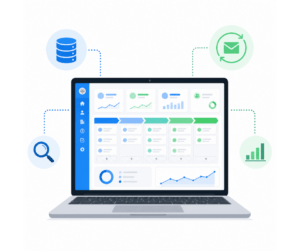
A CRM with built-in data enrichment gives you those inputs in one click: name of the executive, headcount, sector, recent news. You arrive prepared, not as a tourist.
2. Ask for help instead of asking for access
The most effective technique is also the simplest: ask the gatekeeper for advice.
“Hi, I’m hoping you can help me. I’m trying to reach the person who handles [specific topic] on your side. Would you happen to know who I should be talking to?”
You are not asking for access. You are asking for information. That single shift changes the entire dynamic of the conversation.
3. Use the decision-maker’s first name
“Hi, is Sophie around?” sounds far more natural than “Could you put me through to Ms. Martin, the sales director?” The first name suggests you already know the person. The gatekeeper hesitates before blocking someone who sounds like an existing contact.
One caveat: it only works if you have actually done the homework. If the gatekeeper asks “Who’s calling?”, you need to answer with confidence.
4. Call when the gatekeeper is not around
Gatekeepers keep office hours. Decision-makers often don’t. Trying a call at 8:15 in the morning or 6:30 in the evening raises your odds of landing directly on the right person.
This works particularly well with SMB executives, who tend to come in early and leave late.
5. Switch channel
The phone has a gatekeeper. Email and LinkedIn don’t.
A cold email lands straight in the decision-maker’s inbox in most SMB scenarios. A LinkedIn message too. Social selling lets you build a relationship before you ever pick up the phone.
The most effective play combines channels: a first email, then a LinkedIn message that references the email, then a call that references both. At each step, you are a little less of a stranger.
6. Turn the gatekeeper into an ally
This is the most powerful long-term move. Instead of working around the gatekeeper, you get them working for you.
How? By giving them a reason to recommend you.
“I understand Mr. Smith is busy. Would it be okay if I sent you a 2-page document that sums up what I wanted to walk him through? If it looks relevant to you, maybe you can pass it along.”
You respect the gatekeeper’s role. You give them something concrete. And you put them in a position to recommend rather than to block.
The script that works
Here is a sample script for a cold call when you hit a gatekeeper:
“Hi, this is [first name] from [company]. I hope you’re doing well. I’m trying to reach [decision-maker’s first name], is this the right number? … Thanks. It’s about [specific, non-sales topic]. Is he available, or is there a better time for me to call back?”
What makes this script effective:
- You are polite and natural
- You use the decision-maker’s first name (preparation)
- You mention a topic, not a product
- You offer an alternative (calling back later)
- You don’t lie
The gatekeeper in the age of digital prospecting
Digital prospecting has cut the gatekeeper’s power down considerably. With the right tools, you can:
- Find the decision-maker’s work email directly through contact enrichment
- Identify who to contact with ICP search
- Automate your email sequences to follow up without effort
- Use hiring signals to reach out at the right moment
The gatekeeper still stands in the way of phone calls. But by combining phone, email, and LinkedIn, you multiply your chances of reaching the decision-maker without relying on a single channel.
Frequently asked questions about the gatekeeper
How can I tell if I’m talking to the decision-maker or the gatekeeper?
Just ask: “Are you the person who handles [topic] at [company]?” If they redirect you to someone else, it’s a gatekeeper. If they say “yes,” you’re in the right place.
Is cold email more effective than the phone for avoiding the gatekeeper?
Cold email has no gatekeeper: it lands straight in the decision-maker’s inbox. But its average response rate sits between 3 and 8%, versus 5 to 15% for a well-prepared call that gets through the filter. The ideal is to combine the two.
How many times can you call back before becoming intrusive?
Three attempts spread across two weeks is a solid rule. Beyond that, you risk annoyance. If after three calls and two emails you have no reply, move on to another contact inside the same company.